
2026 Professional Development Day Schedule
Intelligent Delivery: The Next Era of Strategy and Analysis with AI
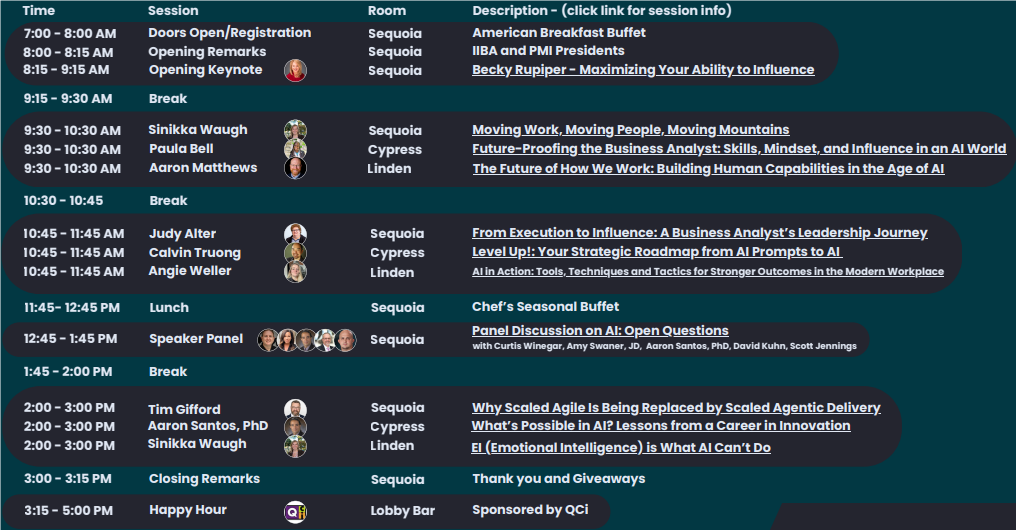
PDD Schedule
There’s still time to become a sponsor—check out our Sponsor tab for more information!
SESSION DESCRIPTIONS
| Becky Rupiper - Maximizing Your Ability To Influence | From influencing direct reports, upper management, solutions to customer requests, or results, influence skills are a critical part of our successful interactions. When asked about influence, most people do not realize the skills to influence are rooted in strategy. We all possess the ability to influence but human nature prevents us from communicating in ways that foster relationship and connect our interests to what is most important to the other party. Which enables us to influence true win-win outcomes. |
During this keynote, participants discover: • The four proven steps to influencing successful outcomes • The importance of separating the person from the issue and building successful relationships • The need to communicate to interests • The art of the right question to uncover underlying interests and communicate value • The five most common behaviors people exhibit when being influenced and how to manage them |
| Sinikka Waugh - Moving Work, Moving People, Moving Mountains | Our ability as leaders to anticipate, navigate, and communicate through change influences the people around us, and that can feel complex when the path ahead seems uncertain. Yet three simple concepts can help move work forward in ways that protect business interests, empower people, and simplify the journey from today to where we want to be. This session blends best practices in change management, emotional intelligence, and project management with personal awareness and productivity to help you reach the right results faster, cleaner, and better, even through uncertainty. |
Gain simple words for identifying and vetting the right idea 2. Practice a model that helps you cast a vision of what you're trying to accomplish 3. Encounter a framework to avoid turbulence in conversations 4. A checklist for engaging the right people in the right way around the solution - to identify goals & roles, tasks & risks 5. Tools to move people forward in a meaningful way from where they are today to where we want them to be with minimal drama, active engagement, and maximum participation |
| Paula Bell - Future-Proofing the Business Analyst: Skills, Mindset, and Influence in an AI World Protect People | AI is changing how work gets done, and redefining the role of the Business Analyst. In this session, we explore the evolving skill set BAs need to stay relevant and influential, from data literacy and AI-supported analysis to prompt engineering and ethical decision-making. Participants will leave with practical guidance for strengthening AI-ready skills starting today. impact. This session explores how business analysts and project leaders can embed empathy, bias awareness, and ethical decision-making into AI requirements and workflows. Participants will learn practical strategies to design AI solutions that enhance trust, fairness, and user experience, ensuring technology supports people rather than unintentionally causing harm Protect People |
i. Identify the core technical, analytical, and human skills required for BAs in an AI-enabled environment ii. Distinguish which traditional BA skills remain critical, and which must evolve iii. Apply AI tools to support requirements analysis, modeling, and documentation iv. Strengthen data literacy to better interpret, question, and validate AI outputs v. Create a personal roadmap for becoming an AI-ready Business Analyst |
| Tim Gifford - Why Scaled Agile Is Being Replaced by Scaled Agentic Delivery | Scaled Agile helped organizations coordinate humans at scale—but coordination is no longer the constraint. This session argues that SAFe is being replaced by Scaled Agentic Delivery, where individuals and teams delegate analysis, planning, and governance work to AI agents. We’ll trace the evolution from Lean and Agile to today’s agentic models, share real-world lessons, and outline how leaders can scale outcomes—not meetings. | Explain why SAFe’s coordination-centric model breaks down in AI-augmented organizations Compare early Agile/Lean patterns with emerging agentic delivery models Identify which BA and PM activities can be delegated to agents today (and which should not) Apply a simple decision framework for shifting work from humans to agents |
| Judy Alter - From Execution to Influence: A Business Analyst’s Leadership Journey | When a Project Manager (PM) wants to help an experienced Business Analyst (BA) grow into a leadership path, their support should go beyond project execution. Every business analyst should strive to be a leader once they become an experienced business analyst. They need to develop a strategic mindset to move from documentation to leadership. The project manager needs to address five main areas with the business analyst for them to move toward a leadership role. My discussion will center around these five main areas using real life examples from my career. I will also address that some business analysts don’t want to be leaders. |
Involve the BA in Strategic Decision-Making Encourage Ownership Beyond Requirements Create Opportunities for Mentorship and Cross-Functional Collaboration Support Professional Development and Visibility Give Constructive Feedback and Leadership Exposure |
| Calvin Truong - The "AI Co-Operator" Maturity Model | Are you still "button mashing" your way through AI? Most professionals have mastered the "Tutorial" - using basic prompts to draft emails or summarize meetings - but the real "End Game" of AI isn't better chatting; it’s strategic orchestration. In the fast-evolving landscape of AI, the competitive edge belongs to those who can transition from being AI users to AI architects. This session provides a roadmap for Project Managers and Business Analysts to evolve their AI maturity through four distinct levels. |
Transition from "Prompt Pilot" to "Strategic Architect": Learn how to shift from manual, one-off prompting to designing automated, multi-agent workflows that monitor project health and predict risks autonomously. b. The ROI of Orchestration over Adoption: Master a framework to evaluate which business processes are ripe for AI automation versus those that require human-in-the-loop oversight to protect project margins and quality. c. Future-Proofing the BA/PM Role: Identify the specific "Level 4 Fluency" skills - including context engineering and system-level auditing - required to lead AI-native teams and deliver measurable strategic value in 2026. |
| Sinikka Waugh - EI (Emotional Intelligence) is What AI Can't Do | In a space being dominated by conversations about AI, we still have to work with humans. “Working with people is the easiest thing in the world” - said no one ever! Collaborating isn’t always easy, and stellar working relationships don’t happen overnight, even for experienced professionals. This workshop incorporates techniques used by seasoned professionals to get the most out of working relationships with team members, sponsors, and even the trickiest of stakeholders. Emotional Intelligence is what AI can’t do. AI has led the conversation for over a year now, and everyone is talking about how to maximize the use of it. But we have to remember that the machine cannot do the emotional side; the human side. We cannot lose sight of the emotional intelligence and advanced collaboration techniques we can bring to the table. In this workshop, you will leverage strategies like positional power, personal power and languages of appreciation to bring your emotional intelligence to the conversation. We will also cover easy to apply tactics and tools like two little words that can diffuse even the stickiest of situations. This workshop contains advanced techniques to move the seasoned professional even further in their career. |
· Consider your stakeholder relationships through a new lens. · Practice techniques in emotional intelligence, without breaking a sweat! · Commit to one thing you’ll do even better, starting right now. |
| Aaron Matthews - The Future of How We Work: Building Human Capabilities in the Age of AI | Everyone is talking about AI tools. Few are talking about what it actually takes to make them work across your teams and organization. This session cuts through the hype with a practical, research-backed framework for building real AI capability. You'll learn why most AI training fails, what separates organizations that see results from those that don't, and how to build systems that keep your team ahead of the curve. |
Why the "Foundation Paradox" may be the biggest hidden risk in your AI strategy A proven framework for scaling AI partnership across your team How to build an organizational learning engine that compounds over time A 30-day action plan to launch real capability, not just another training initiative |
| Aaron Santos - What’s Possible in AI? Lessons from a Career in Innovation | Innovating with AI is necessary for business survival, but the principles that drive successful innovation are often very different from those that guide traditional business processes. In this session, Santos draws on years of experience in both academia and industry to explore the “art of the possible” in AI. Topics in this session include demystifying how AI works, hidden problems AI is solving, and strategies for successfully doing business innovation. | A clear, practical understanding of how AI works Real examples of unexpected problems AI is solving Principles for successfully introducing AI-driven innovation in organizations |